
With the summer nearing an end, it’s time for MAYS to find its new co-coordinator! After 2 fruitful years of helping the network grow, Matteo Valoncini is moving on and we are seeking someone who can take over his role as one of MAYS co-coordinators.
We are seeking candidates for the 2-year role of MAYS co-coordinator. The candidates will be voted for in general MAYS Coordinator Elections – the polls will open by 26th September and stay open till mid-October when the new co-coordinator is announced.
To apply you must be a doctoral student or an early-career academic in a European university, and have about a full day or two per month minimum, on average, to take the coordinator responsibility.
To apply, please, fill up this formby September 24th, the end of the day. To apply you will need to submit your academic CV and provide:
A short synopsis of your research interests and projects.
Experiences that speak to your eligibility for the role.
What would be your plans for the next meeting and for MAYS in general?
Application deadline: 24 September 2025, till the end of the day.
Plural perspectives and evolving practices in Medical Anthropology
The Medical Anthropology Young Scholar Network is pleased to announce its 16th Annual Meeting for 2025 Plural Perspectives and Evolving Practices in Medical Anthropology. We invite scholars, health practitioners, and researchers from diverse disciplinary and academic backgrounds to contribute to an engaging and thought-provoking dialogue.
Health, illness and healing are deeply multifaceted concepts, shaped by diverse epistemologies, socio-cultural contexts, and power dynamics. Medical anthropology, as a field, offers a versatile lens of observation through which explore these complexities while critically reflecting on its own practices and methodologies. We aim to foster a global dialogue that transcends the epistemological limitations of traditional academic boundaries. Highlighting and interrogating gaps between academic inquiry and local knowledge systems, this meeting seeks to push disciplinary boundaries and explore pathways toward equity in our fields of study in order to explore new possibilities in evolving research approaches. By equity, we refer to the commitment to fair and just research practices that acknowledge historical and structural inequalities, ensuring that marginalized perspectives are meaningfully valued. This includes redistributing power in knowledge production, fostering reciprocal collaborations, and challenging dominant frameworks that perpetuate exclusion. By doing so, this meeting also aims to push the engagement with more decolonial perspectives on medical anthropology. Recognizing the enduring influence of colonial thought on global health approaches, research methodologies, and practices of care, we invite reflections that interrogate these legacies and propose transformative pathways toward equity and justice.
Therefore, we encourage submissions that can be either reflexive, theoretical, ethnographical or historical and the participation of everyone – especially early career researchers from every field, but also practitioner and social workers – in their work, come across questions such as, but not limited to:
Decolonial critiques of health and healing practices: thinking and discussing decolonial approaches challenging the dominance of the Global North epistemologies and strive to decenter and critique Eurocentric frameworks in health research and practice. Reflecting also on structural inequities and the power imbalances that shape global health interventions.
Ethnography and positioning in healthcare fields: within this framework it is necessary to reflect and reimagine research ethics and methodologies to be more inclusive and collaborative. By engaging with these critical issues, the meeting seeks to invite reflections on applied methodologies of research in the field of healthcare and healthcare humanities.
Intersectional challenges and opportunities in global health research: by bridging gaps between academic inquiry and local knowledge systems, this meeting seeks to push disciplinary boundaries and explore pathways toward equity in our fields of study in order to explore new possibilities in evolving research approaches.
Efforts to amplify marginalized voices and address inequities in research and practice: contributions that bridge academic inquiry with lived experiences, grassroots initiatives, and policy-making are particularly encouraged. In this regard, we also welcome reflections on how activist and grassroots movements engagements shape medical anthropology, from influencing research ethics to driving structural change in health and healing practices.
Application Process
We invite you to submit an abstract of no more than 350-500 words at the link below by April 7th. Notifications of acceptance will be sent by the middle of April.
Deadline for Abstract Submission (350-500 words): April 7th, 2025 Notification of Acceptance: April 16th, 2025 Deadline for Paper Submission (3,000-5,000 words): June 1st, 2025
Format of the Meeting
At the meeting, sessions will be organized based on thematic overlap. Participants will be paired with a discussant for every session who will comment on their work after their presentation. The discussant’s role includes introducing the session, identifying the common thread linking all presentations, and facilitating reflections and questions. To ensure a well-prepared discussion, we ask each participant to submit a paper of 3,000-5,000 words by June 1st, allowing discussants to organize their time effectively.
Given the nature of the meeting – intended as both a safe, judgement-free space and a possible springboard for other conferences – this year we welcome candidates who are curious about taking on the role of discussant. You can apply to be a discussant while submitting your abstract by selecting the relevant option in the submission form. We will discuss the details once the forms are filled in; marking yourself as interested in the first form does not imply any obligation at this early stage.
More information on workshops, keynotes, and events will follow in due time.
Beyond the meeting presentations, we will organize a social picnic by the forest near the campus on the 2nd of July.
The meeting will have a hybrid format.
Participation fee
In order to cover basic expenses, we ask for a 30 EUR participation fee for in-person participants, to be paid in cash upon arrival (offline participation).
Financial Support
A small amount of funding is available for EASA members taking part in the Annual Meeting in person and who have financial need. Funding will be given in the form of a fixed stipend based upon the number of participants requesting funding (likely around 80 Euro). If you would like to request funding for this meeting, we ask that you indicate this on your registration form. For those that may be able to secure funds from elsewhere (i.e. departmental funding) this would help us to provide a greater amount of funds to those without any sources of funding. We are aware that the price of accommodation in Tilburg can be prohibiting, and we will try to work with participants to find affordable options. Concrete details on accommodation will be forthcoming after abstract acceptances.
We look forward to welcoming you in Tilburg!
MAYS Coordinators (mays.easa@gmail.com)
Simona Maisano, Department of Humanities, University for foreigners of Siena

Matteo Valoncini, Department of History and Cultures, University of Bologna
With the summer nearing an end, it’s time for MAYS to find its new co-coordinator! After 3 fruitful years of helping the network grow, Robert Smith is moving and we are seeking someone who can take over his role as one of MAYS co-coordinators.
We are seeking candidates for the 2-year role of MAYS co-coordinator. The candidates will be voted for in general MAYS Coordinator Elections – the polls will open by the end of August and stay open till mid-September when the new co-coordinator is announced.
To apply you must be a doctoral student or an early-career academic in a European university, and have about a full day or two per month minimum, on average, to take the coordinator responsibility.
To apply, please, fill up this formby August 31st, the end of the day. To apply you will need to submit your academic CV and provide:
A short synopsis of your research interests and projects.
Experiences that speak to your eligibility for the role.
What would be your plans for the next meeting and for MAYS in general?
Application deadline: 31 August 2024, till the end of the day.
Critical Anthropology and Global Health: Challenges and Possibilities
Global Health perspectives have provided a more holistic approach to health, leading to the emergence of several programs, mostly in medical departments, around the 2000’s that comprehensively address health issues. Within the framework of Global Health, researchers are actively involved in addressing emerging issues related to health, illness, and the human body, contributing to the creation of a more integrated and comprehensive foundation for health-related investigations and implementations. However, critical medical anthropology has highlighted a rising ethical problem within this framework. Global Health – as an area of interests, research and practices – shaped a division between a healthy Global North and sick Global South. While epidemiological inquiries initiated this stereotype, one can see that such a division has gone beyond the presence or absence of diseases, it is gradually rooted within cultural, economic, environmental, infrastructural, political, social, and technological processes, also contributing in reinforcing the epistemic centralities of academia in the Global North.
This year’s MAYS Annual Meeting critically focuses on the relationship between Global Health and medical anthropology. Since the division between Global North and Global South now clearly goes beyond clinical or public health programs, critical global health studies have broadened, and the boundaries of disciplines have loosened. Understanding the processes that produce health means looking not only at the relationships between social actors, but also at the relationships between those actors and the environment, infrastructures, flora, fauna, or bacteria; anything that can be called non-human. As the division evolves within the intersection of Human and Non-Human elements, medical anthropology’s critical approach may require a reevaluation of its inquiry framework, aiming for transformative engagement with our ‘field’. In particular, we want to dwell on the role of ethnographic sensibilities that bring forward non-humans and their often-overlooked influence on the way humans experience, perceive, and construct health, illness, and the body. We welcome critical insights that explore such topics beyond disciplinary barriers. We invite medical anthropologist, social epidemiologist public health experts or geographers, among others, who in their work come across questions such as:
What does it mean to study “health” today, when it is defined so differently by various stakeholders across the globe?
What does anthropological research do or could do within Global Health projects?
What is the future of Global Health?
How and when are ethnographic approaches used in Global Health studies?
What kind of knowledge do they produce and how? How do the different disciplines find or do not find a space of dialogue with each other?
We invite papers that fall into one of the following categories:
Discussions on interdisciplinarity in the social studies of health – thinking and discussing research topics and fieldwork experiences that lie at the intersections of disciplines and epistemologies, facing conceptual frictions between different definitions of health, disease, illness, and bodies.
Mixing methods in Global Health research – experiences and questions on how to approach research topics creatively, mixing ethnography with action-research or quantitative approaches, both inside and outside of academia.
Rethinking Global Health as a concept – bring a critical perspective on the current state of Global Health studies and its boundaries, aiming to answer a question of how to best mix academic curiosity with practicality of applied research approaches, including reflecting on the historical roots of the framework and its heritage. What are the different ideas of the role a researcher should play socially? Can we further debate on Global Health’s validity as an established research paradigm?
Application Process
We invite you to submit an abstract of no more than 350-500 words at the link below by April 8th, and notification of acceptances will be sent by the end of April.
Deadline for Abstract Submission (350-500 words): April 8th, 2024 Notification of Acceptance: April 29th, 2043 Deadline for Paper Submission (3,000-5,000 words): June 1st, 2024
Format of the Meeting
At the meeting, sessions will be organized based on the thematic overlap. Participants will be paired with a discussant that will comment on their work after their presentation. For this purpose, we ask you to submit a paper of 3,000-5,000 words by June 1st. More information on workshops, keynotes, and events will follow in due time.
Beyond the meeting presentations, we will organize a social picnic by the hill accessible by a short hike on June 20th.
The meeting will have a hybrid format.
Participation fee
In order to cover basic expenses, we ask for a 30 EUR participation fee for in-person participants, to be paid in cash upon arrival (offline participation).
Financial Support
A small amount of funding is available for EASA members taking part in the Annual Meeting in person and who have financial need. Funding will be given in the form of a fixed stipend based upon the number of participants requesting funding (likely around 80 Euro). If you would like to request funding for this meeting, we ask that you indicate this on your registration form. For those that may be able to secure funds from elsewhere (i.e. departmental funding) this would help us to provide a greater amount of funds to those without any sources of funding. We are aware that the price of accommodation in Geneva can be prohibiting, and we will try to work with participants to find affordable options. Concrete details on accommodation will be forthcoming after abstract acceptances.
We look forward to welcoming you to Bologna!
MAYS Coordinators (mays.easa@gmail.com)
Matteo Valoncini, Department of History and Cultures, University of Bologna
Robert D. Smith, Department of Anthropology and Sociology, Geneva Graduate Institute
Please find below details onthe Fourth Online Workshop: “The Hospital in Transit”, This time, workshop will be dealing with: “Hospital Collaborations”.
We will explore questions like: What is the changing global role of hospitals? Do our research methods also have changed after COVID-19? Both penetrable and secluded social spaces, hospitals have a thick history with anthropology.
During the workshop we will discuss 4 thought-provoking ethnographic case presentations:
“Healthcare providers and anthropologists in collaboration: A case study from a gynaecological and obstetric service of a hospital in Barcelona”, Mariana Campos Lichtsztejn and Anna Molas Phd candidate at Universitat Autònoma de Barcelona
“Hospital fieldwork as a social experimental setting: Insights from a paediatric and maternal hospital in Barcelona”, Paula Martone, MSc – Phd Candidate AFIN Research Group, Departament d’Antropologia Social i Cultural, Universitat Autònoma de Barcelona
“Navigating in a Foreign Field: Obstacles in front of Hospital Access for Ethnographers in Turkey” Öykü İnal, Freie Universät Berlin
“Anthropology and Quality Improvement in UK NHS Mental Health Services”, Matthew Day, Anthropology PhD Research Student, School of Anthropology and Conservation, University of Kent
Chair: Mirko Pasquini PhD, Centre for Medical Humanities, Uppsala University (mirko.pasquini@antro.uu.se)
As MAYS we share what EASA published with respect to the current situation in Gaza.
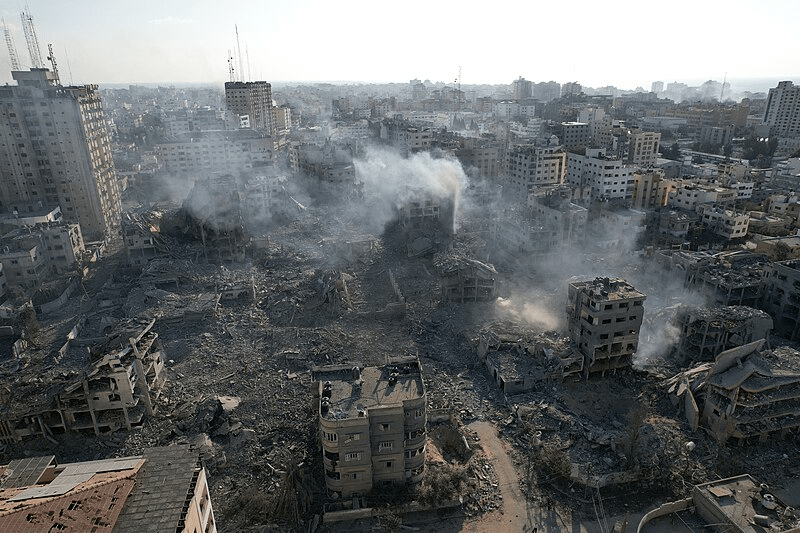
Residential buildings 150 m from the Palestinian Tower, which were destroyed during the first week of intensive bombing by Israeli aircraft. Source: Al Araby, License
The executive committee of the European Association of Social Anthropologists extends its solidarity to those mourning the loss of their loved ones in both Palestine and Israel.
We strongly condemn the violence perpetrated by the Israeli state against the civilians of Gaza. This concerns all the forms of violence inflicted upon Palestinians: air strikes claiming indiscriminately the lives of a population half of which are children; the massive destruction of livelihoods and infrastructure – including hospitals, schools, mosques, churches, and the Islamic University of Gaza; the starving of the population by cutting its access to water, electricity, fuel, food, medical supplies, and humanitarian aid.
As anthropologists with expertise on state violence, human rights, peace, conflict and security, we warn against decontextualised narratives of conflict and ‘terrorism’. The genocidal framing of Palestinians as culprits, as ‘human animals’, and as deserving of collective punishment has already incited murderous hatred against Muslims and Arabs in other parts of the world, and is likely to further subject Palestinians in Gaza and the West Bank to settler violence, adding to the state violence they are already victims of.
As anthropologists based in Europe, we also strongly condemn the support of the EU and of European governments to acts amounting to war crimes under international law. We urge governments to respect international law provisions that protect civilians and to understand that their actions and words bear heavy consequences likely to spill over in generalised violence against Arabs, Muslims, Palestinians, and those who support their plight – including the many dissenting voices in Israel and elsewhere.
We are deeply concerned about the repressive measures taken in some universities, in Europe and elsewhere, against those who expressed their solidarity with Palestinians and were suspended or harassed. This totalitarian silencing of dissent in the face of violence and war is unacceptable and in full dissonance with the goal of higher education to foster critical thinking among students and the public. We also condemn the violent repression of peaceful protests in Europe and elsewhere.
We heed the call of our colleagues from Birzeit University to speak up against genocidal violence, occupation, and the flagrant violation of human rights in Gaza and the Palestinian Occupied Territories, and call for the academic community to fulfil its mission of critique towards oppressive structures, of warning against the rippling effects of violence and occupation, and of speaking truth to power.
We call for an immediate ceasefire and immediate humanitarian relief for the people of Gaza, and a commitment from Israel and all governments to a peace process that deals with the historic inequalities, injustice and structural violence in the region.
Ana Ivasiuc, President EASA On behalf of EASA’s Executive Committee
As Magdalena Góralska has stepped down as MAYS co-coordinator, after being on the post for three year, it has been time to elect the next MAYS co-coordinator.
This year, there was one candidacy of Matteo Valoncini, of the University of Bologna. His candidature received unanimous support from the MAYS community, with all votes cast in favor of Matteos candidacy. Matteo will remain MAYS co-coordinator for the next two academic years. Robert Dean Smith will remain as a co-coordinator for an additional year, serving the community for a total of two years.
Matteo Valoncini
Matteo Valoncini is a Ph.D. student at the Department of History and Cultures at the University of Bologna, where he also completed his Master’s degree in Cultural Anthropology and Ethnology. His primary field of study is medical anthropology, in particular, the topic of digital technologies in healthcare – he is currently working on an ethnography of the digitization of primary healthcare in Italy by cross-referencing ANT with medical anthropology. As he is trying to understand how digitalized medical records affect the conception of body, health and disease, Matteo enjoys practising yoga, playing board games, and hiking in the Alps.
He first learned about the network at the EASA’s 2022 Biennial Conference in Belfast, and after participating in the MAYS’s Annual Meeting in 2023, decided to apply for the coordinatorship. To Matteo being part of the network is an incredibly enriching opportunity, and he hopes to support its stability, ensure its strength and further its growth. You can reach Matteo through e-mail: matteo.valoncini2[at]unibo.it.
As Chandni Shyam has stepped down as MAYS co-coordinator at the end of October, after being on the post for a year, it has been time to elect the next MAYS co-coordinator.
This year, there was one candidacy of Robert Dean Smith, of the GenevaGraduate Institute. His candidature received unanimous support from the MAYS community, with all votes cast in favor of Robert’s candidacy. Robert will remain MAYS co-coordinator for the next two academic years. Magdalena Góralska will remain as a co-coordinator for an additional year, serving the community for a total of three years.
Robert Dean Smith
PhD Student, Department of Anthropology and Sociology, the Geneva Graduate Institute
Robert completed his bachelor’s degree in Global Health and Social Medicine at King’s College London, before completing his MA in Anthropology and Sociology at the Geneva Graduate Institute. He previously conducted research on how cancer came to be seen as a health priority in colonial India, which led him to his current research interests in the relationships between politics and health; both as the politics of health seen within health austerity, and the ways that health becomes a form of politics within electoral competitions in India. Robert has also worked in professional roles that have aimed to bring social science perspectives to public health discussions, including ‘digital health’ and sexual and reproductive health and rights. Beyond the academic world, Robert enjoys cooking creative food. You can read more of Robert’s work here, and reach Robert by e-mail at: robert.smith@graduateinstitute.ch.
As it is offcially the fall again, it’s time for Coordinator Elections in MAYS!! Do you want to take an active role in connecting students and early career scholars with an interest in Medical Anthropology? Would you like to organize the next MAYS conference? Do you have ideas about how to expand and deepen the MAYS network? Would you like to expand your skills and contacts and become an organizing member of EASA?
To apply you must be a doctoral student or an early-career academic in a European university, and have about a full day or two per month minimum, on average, to give to our quickly growing community. The co-coordinator post is a two-year post. A new coordinator will take place of Chandni Shyam, who needed to resign early from her post and work alongside Magdalena Góralska, who will stay as the second co-coordinator for another year.
If you would like to apply please sent us an emailto mays.easa@gmail.com with two attachments: (1) your academic CV, and (2) a Word document with short answers of not more than 200 words to each of those three following prompts:
A short synopsis of research interests and projects.
Experiences that speak to your eligibility for the role.
What would be your plans for the next meeting and for MAYS in general?
Application deadline: 23 October 2022, till the end of the day.
Thank you in advance for your interest and application! If you have any questions regarding the application and/or MAYS coordination, please do not hesitate to contact us at mays.easa@gmail.com.